01RTP
Real-Time Perception
Reason over synchronized audio and video while events are still unfolding.
263 tasksOverview
StreamArena moves streaming-video evaluation beyond short clips and multiple-choice shortcuts toward continuous, causal, and interactive understanding.
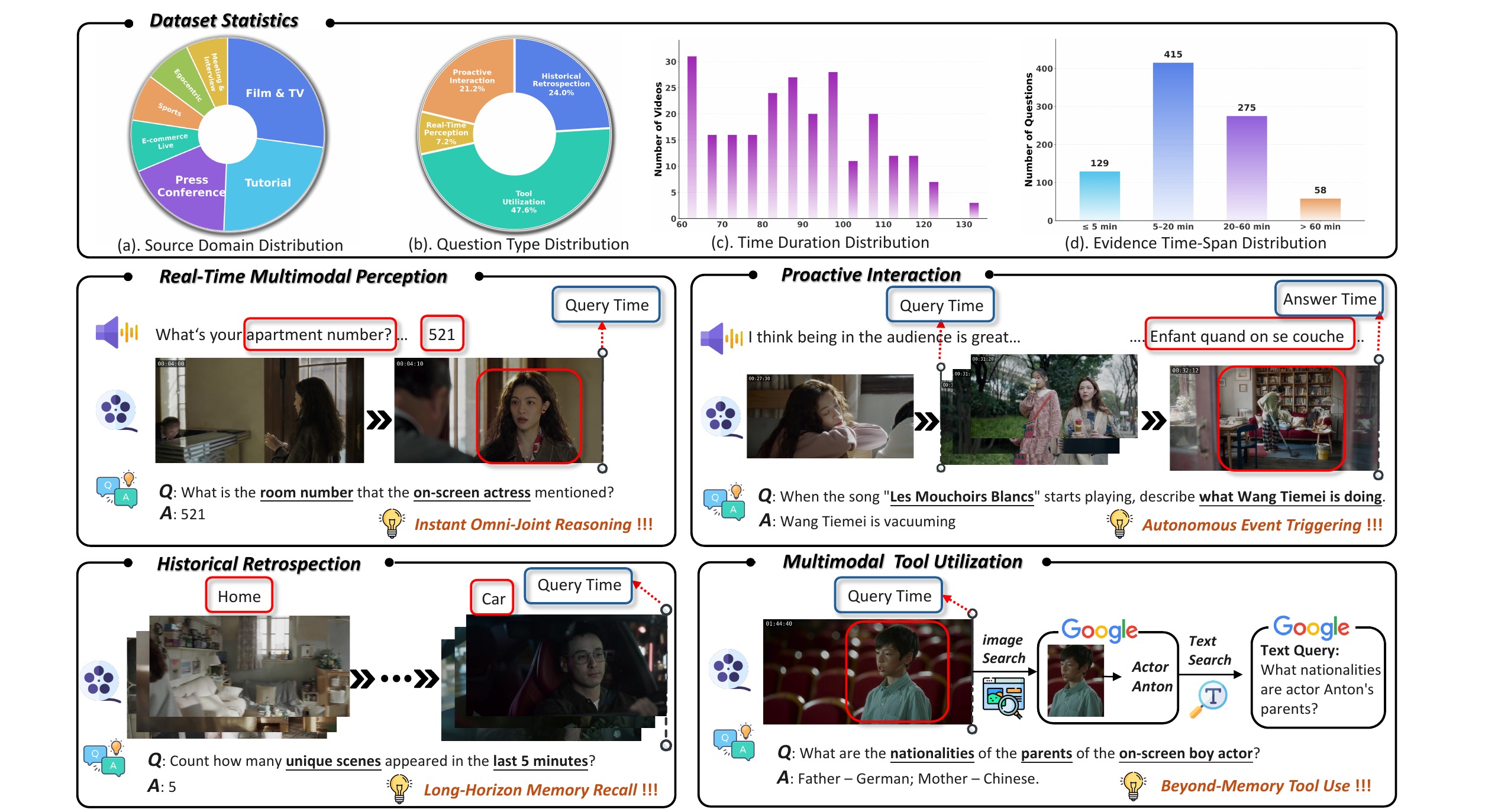
Real-world multimodal agents must continuously ingest unbounded audio and video, remember what happened long ago, interact at low latency, and decide when to use tools or speak proactively. Existing benchmarks usually test only fragments of this behavior.
StreamArena provides full-length streams and open-ended tasks under strict causal access, exposing the trade-off between responsive interaction and persistent multimodal understanding.
Abstract
Deploying autonomous multimodal agents in continuous, real-world environments requires them to ingest unbounded audio-visual streams and maintain hour-scale memory. Yet current evaluations predominantly rely on brief clips and multiple-choice formats, where recent-frame baselines and language shortcuts can hide fundamental limitations.
We introduce StreamArena, a benchmark for hour-scale, interactive streaming video understanding. It contains 243 full-length videos averaging 88.8 minutes and 3,646 rigorously annotated, open-ended question-answer pairs spanning real-time perception, historical retrospection, proactive interaction, and multimodal tool utilization.
We further propose StreamMind, a two-tier architecture that assigns latency-critical interaction and monitoring to frontend workers while backend workers asynchronously build persistent multimodal memory, retrieve historical evidence, and perform external search. StreamMind leads streaming baselines across all four capabilities while reducing query-to-answer latency through persistent state reuse.
The Benchmark
Each capability targets a distinct failure mode that static, turn-based evaluation cannot fully reveal.
Reason over synchronized audio and video while events are still unfolding.
263 tasksRetrieve distant evidence from an hour-scale stream without seeing the future.
877 tasksGround visible entities, identify information gaps, and search beyond memory.
1,732 tasksMonitor future conditions and speak at the right moment without a new prompt.
774 tasksPhD-level annotators create multi-turn tasks.
Two annotators independently answer and correct.
A third annotator verifies content and timestamps.
Benchmark Comparison
Existing benchmarks typically isolate one or two streaming abilities. StreamArena combines hour-scale video, causal access, multimodal input, dialogue, proactive triggering, and external tools in one protocol.
| Benchmark | Venue | Anno. | Answer | Q/Vid | Dur. (min) | Long | Stream | Omni | MT | Pro. | Tool |
|---|---|---|---|---|---|---|---|---|---|---|---|
| Offline long / omni-modal video benchmarks | |||||||||||
| Video-MME | CVPR ’25 | Manual | MC | 3 | 17.0 | ✓ | — | ✓ | — | — | — |
| LongVideoBench | NeurIPS ’24 | Manual | MC | 2 | 7.9 | ✓ | — | — | — | — | — |
| MLVU | CVPR ’25 | Manual | Mixed | 2 | 15.5 | ✓ | — | — | — | — | — |
| Online / streaming video benchmarks | |||||||||||
| StreamingBench‡ | ICLR ’25 | Hybrid | MC | 5 | 9.7 | — | ✓ | ✓ | ✓ | ◐ | — |
| OVO-Bench‡ | CVPR ’25 | Hybrid | Mixed | 4 | 3.5 | — | ✓ | — | — | ◐ | — |
| OVBench | CVPR ’25 | Hybrid | MC | 11 | 5.5 | — | ✓ | — | ✓ | — | — |
| RTV-Bench | NeurIPS ’25 | Hybrid | MC | 8 | 18.2 | — | ✓ | — | — | — | — |
| OST-Bench | NeurIPS ’25 | Hybrid | Mixed | 7 | N/A | — | ✓ | — | — | — | — |
| Proactive / duplex streaming benchmarks | |||||||||||
| OmniMMI | CVPR ’25 | Manual | Mixed | 2 | 5.4 | — | ✓ | ✓ | ✓ | ✓ | — |
| QIVD (Qualcomm) | ICLR ’26 | Manual | Open | 1 | 0.09 | — | ✓ | ✓ | — | ✓ | — |
| Ours | |||||||||||
| StreamArena | — | Manual | Open | ≈15 | 88.8 | ✓ | ✓ | ✓ | ✓ | ✓ | ✓ |
◐ denotes partial proactive support through separate queries rather than continuous monitoring. ‡ marks benchmarks with documented recency shortcuts. Values follow the paper comparison table.
Method
A two-tier architecture keeps interaction responsive while long-horizon cognition runs asynchronously.
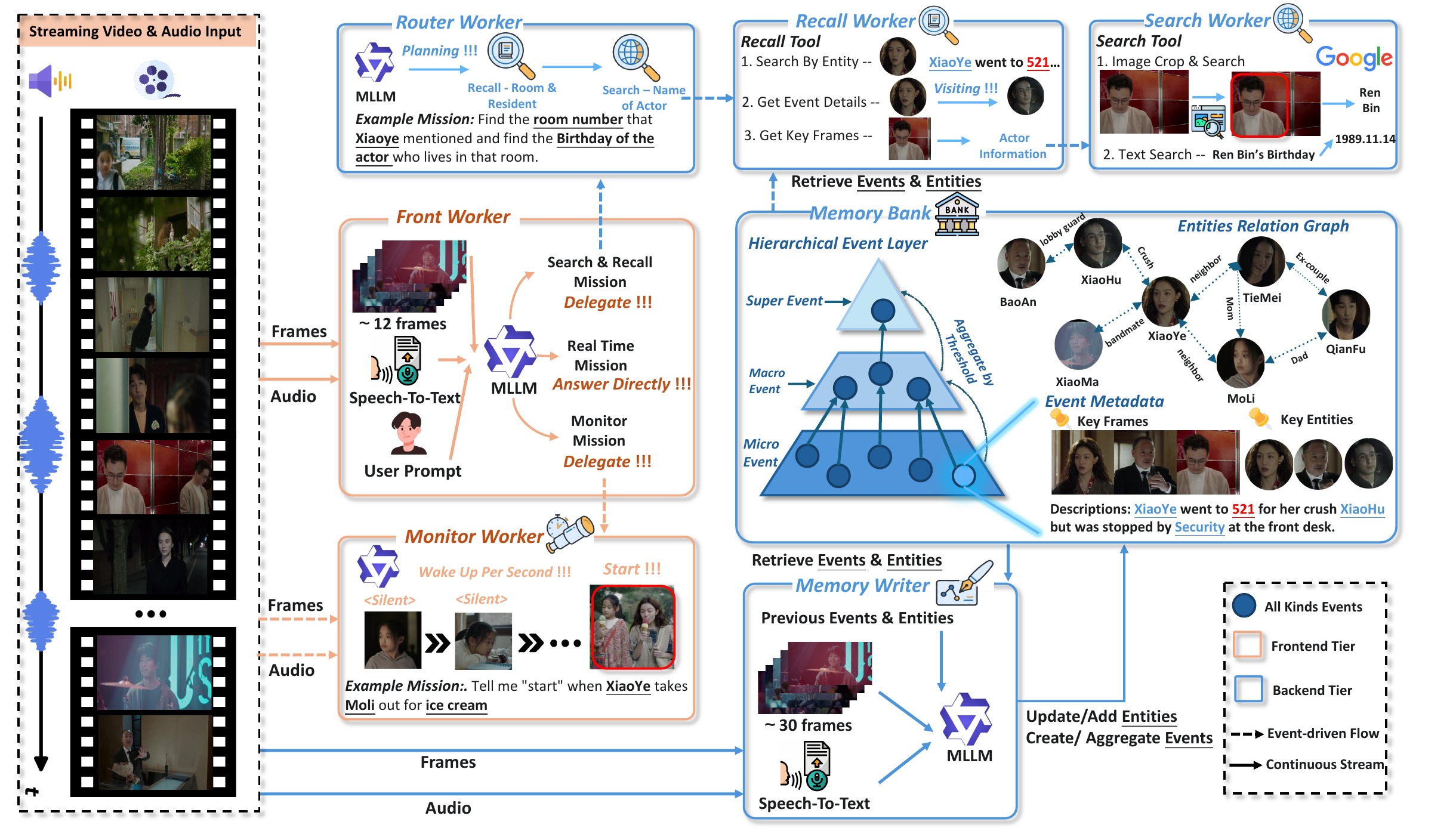
The Front Worker answers from recent context, delegates retrieval, or launches independent Monitor Workers for future conditions.
The Memory Writer organizes events hierarchically while preserving entity relations and retrievable key frames.
Router, Recall, and Search Workers coordinate historical evidence and external information without blocking live interaction.
Key Results
StreamMind ranks first among evaluated streaming systems on every target capability.
Main Results
Category averages from the full paper table, in percent.
| Class | Method | RTP ↑ | HR ↑ | Tool ↑ | Pro. ↑ |
|---|---|---|---|---|---|
| Human | Human (streaming) | 91.8 | 63.4 | 95.2 | 91.5 |
| Offline | Qwen3.5-397B-A17B | 44.1 | 41.5 | 62.2 | — |
| Offline | MiMo-V2.5 | 38.0 | 35.8 | 47.9 | — |
| Offline | Kimi-K2.6 | 47.9 | 43.8 | 60.9 | — |
| Offline | Gemini 3.5 Flash† | 51.3 | 51.4 | 70.8 | — |
| Offline | Qwen3.5-Omni† | 41.8 | 35.8 | 49.4 | — |
| Recent window | AURA‡ | 28.1 | 22.7 | — | 3.7 |
| Recent window | MiniCPM-o-4.5‡ | 22.1 | 9.8 | 17.1 | 7.5 |
| Text summary | VST‡ | 24.0 | 21.2 | — | — |
| Internal compression | StreamForest | 17.9 | 14.4 | — | — |
| Internal compression | ThinkStream | 8.0 | 7.5 | 1.8 | 1.2 |
| Ours | StreamMind | 44.5 | 34.9 | 56.1 | 11.6 |
HR is question-weighted across four evidence-to-query gaps; Pro. is weighted across three monitoring horizons. † closed-source model; ‡ author-finetuned backbone; — unsupported or not applicable.
Online Latency
Accuracy and mean latency in seconds.
| Method | ACC ↑ | RTP ↓ | HR ↓ | Tool ↓ |
|---|---|---|---|---|
| Gemini 3.5 Flash† | 63.1 | 86.9 | 123.9 | 139.5 |
| Kimi-K2.6 | 54.5 | 162.8 | 187.9 | 128.2 |
| Qwen3.5-397B-A17B | 54.2 | 83.8 | 117.4 | 62.8 |
| Qwen3.5-Omni† | 44.6 | 50.8 | 56.4 | 103.7 |
| MiMo-V2.5 | 43.3 | 224.5 | 266.5 | 187.4 |
| StreamMind | 48.6 | 12.9 | 30.7 | 28.1 |
Conclusion
StreamArena evaluates the complete loop of continuous perception, long-horizon memory, tool use, and proactive interaction. StreamMind shows that separating real-time interaction from asynchronous multimodal memory is a promising path toward practical always-on agents.
Hour-scale streams, open-ended questions, timestamped evidence, and causal access expose shortcuts hidden by short clips and answer choices.
Decoupling the responsive frontend from asynchronous memory, recall, monitoring, and search improves all four target capabilities.
Hour-scale recall, proactive monitoring, smaller backbones, and continuous-processing efficiency remain concrete open directions.
BibTeX
@misc{zhang2026streamarenacontinuousinteractivelonghorizon,
  title={StreamArena: Toward Continuous, Interactive, and Long-Horizon Agentic Streaming Video Understanding},
  author={Xichen Zhang and Guankai Li and Yinghao Zhu and Shijian Wang and Sitong Wu and Shaozuo Yu and Meng Chu and Yuan Lu and Jiaya Jia},
  year={2026},
  eprint={2608.05703},
  archivePrefix={arXiv},
  primaryClass={cs.CV},
  url={https://arxiv.org/abs/2608.05703},
}